
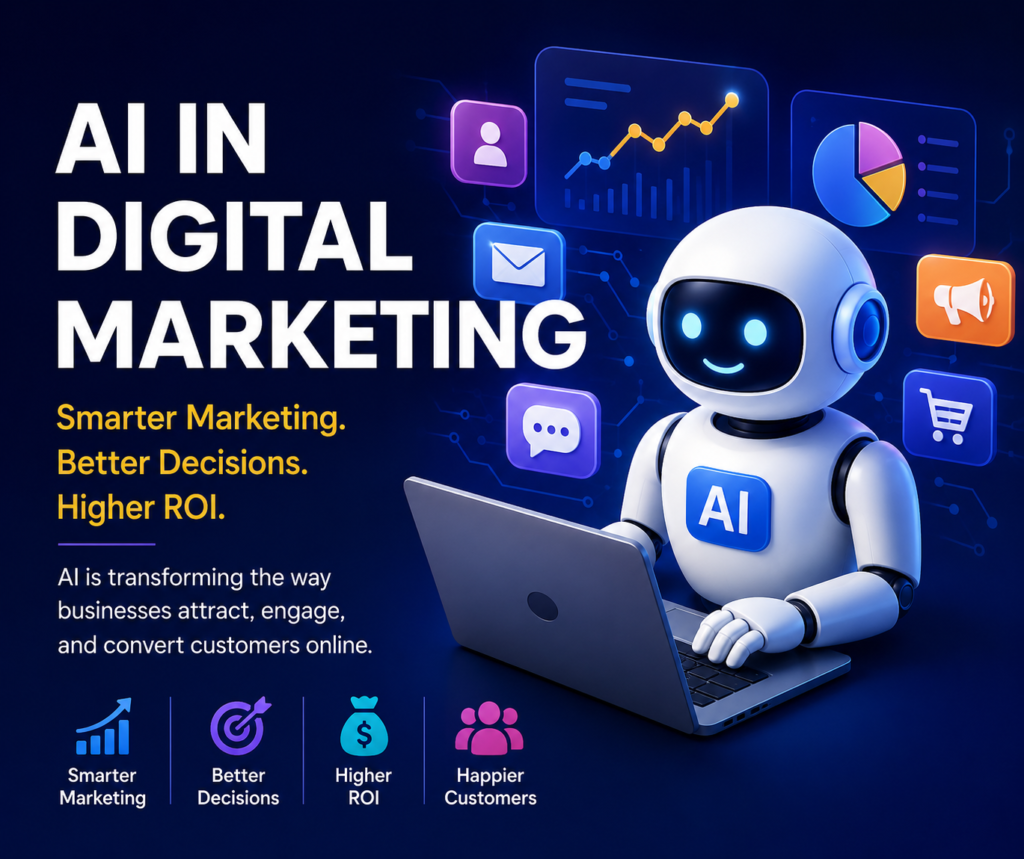
AI in Digital Marketing: A Complete Guide to How Artificial Intelligence Is Transforming Marketing
What Is AI in Digital Marketing?
Artificial Intelligence (AI) in digital marketing refers to the use of intelligent technologies to automate tasks, analyze customer behavior, create content, optimize campaigns, and improve marketing decisions. Today, AI helps businesses deliver personalized experiences, predict customer actions, and make data-driven marketing decisions faster than ever before.
Quick Fact: AI can identify customer behavior patterns that are often too subtle for humans to detect, helping marketers optimize campaigns earlier.
AI in Digital Marketing at a Glance
| Feature | Traditional Marketing | AI-Powered Marketing |
|---|---|---|
| Content Creation | Manual | AI-assisted |
| Customer Insights | Historical reports | Real-time analysis |
| Personalization | Limited | Dynamic personalization |
| Advertising | Manual optimization | AI-driven optimization |
| Customer Support | Human only | AI chatbots + Humans |
| Campaign Decisions | Based on experience | Based on predictive analytics |
Frequently Asked Questions (AEO)
What is Artificial Intelligence?
- Artificial Intelligence enables machines to learn, reason, and solve problems similar to humans.
- AI uses Machine Learning, Deep Learning, and Natural Language Processing (NLP).
- It powers recommendation systems, chatbots, search engines, and marketing platforms.
Did You Know?
AI systems can discover customer patterns that marketers may never notice manually.
How does AI help digital marketing?
AI helps businesses:
- Automate repetitive marketing tasks
- Create high-quality content
- Personalize customer experiences
- Improve Google Ads performance
- Optimize Meta Ads campaigns
- Predict customer behavior
- Generate marketing reports
- Improve SEO strategies
Rare Fact
Modern AI can personalize website content for each visitor without creating separate webpages.
Why is AI important in digital marketing?
AI allows marketers to:
- Save time
- Reduce manual work
- Increase campaign accuracy
- Improve customer engagement
- Make faster business decisions
- Scale marketing efforts efficiently
Can AI replace digital marketers?
No.
AI automates repetitive tasks, but creativity, strategic planning, relationship building, and business decisions still require human expertise.
Fact
The best-performing marketing teams combine AI with human creativity instead of replacing people.
AI Technologies Used in Digital Marketing
| AI Technology | Purpose |
| Machine Learning | Learns from marketing data |
| Generative AI | Creates content |
| Natural Language Processing | Understands human language |
| Predictive Analytics | Forecasts customer behavior |
| AI Agents | Automates workflows |
| Large Language Models (LLMs) | Generate human-like responses |
What is Machine Learning?
Machine Learning is a branch of AI that learns from historical data to improve predictions and recommendations.
Common Uses
- Product recommendations
- Customer segmentation
- Email personalization
- Fraud detection
- Sales forecasting
Rare Fact
Many recommendation engines become more accurate automatically as they receive more customer interaction data.
What is Generative AI?
Generative AI creates:
- Blog articles
- Social media posts
- Product descriptions
- Marketing emails
- Images
- Videos
- Ad copy
Rare Fact
Generative AI can create multiple campaign variations from a single prompt, making A/B testing much faster.
What are Large Language Models (LLMs)?
Large Language Models are AI systems trained on massive amounts of text to understand and generate human language.
Examples include:
- ChatGPT
- Google Gemini
- Claude
- Perplexity
Rare Fact
LLMs predict the next most likely token based on context—they do not simply search a database for answers.
How Can ChatGPT Help Digital Marketers?
ChatGPT can assist with:
- SEO content writing
- Blog generation
- Email marketing
- Social media captions
- Keyword clustering
- FAQ creation
- Customer support
- Brainstorming content ideas
Interesting Fact
ChatGPT accelerates content creation, but expert review remains essential for factual accuracy and brand consistency.
What Is Google Gemini?
Google Gemini is Google’s multimodal AI model capable of processing text, images, audio, video, and code.
Marketing Uses
- Keyword research
- Content planning
- Market research
- Image analysis
- Productivity workflows
What Is Claude AI?
Claude is designed for long-form reasoning and document analysis.
It is commonly used for:
- Research
- Policy analysis
- Long-form content
- Business documentation
What Is Perplexity AI?
Perplexity AI is an AI-powered answer engine that provides conversational responses with citations.
Benefits
- Faster research
- Source-backed answers
- Competitive analysis
- Industry insights
AI and SEO
How does AI improve SEO?
AI helps marketers:
- Find keywords
- Build topic clusters
- Optimize content
- Generate FAQs
- Improve internal linking
- Create meta descriptions
- Detect content gaps
- Analyze competitors
Rare Fact
Search engines increasingly understand entities and relationships instead of relying only on exact keywords.
What is Entity SEO?
Entity SEO focuses on recognized concepts like people, organizations, products, and places instead of isolated keywords.
Examples of entities include:
- Brands
- Products
- Technologies
- Services
- People
Rare Fact
A website with strong entity relationships is more likely to appear in AI-generated answers.
What is Semantic Search?
Semantic Search helps search engines understand meaning rather than matching exact keywords.
Benefits
- Better search accuracy
- Contextual understanding
- Improved AI search results
- Better user experience
Did You Know?
Two pages with different wording can rank for the same search if they explain the same concepts thoroughly.
What are AI Overviews?
Google AI Overviews generate summaries by combining information from multiple trusted sources.
AI Overviews typically prioritize:
- Expert content
- Clear answers
- Trusted websites
- Structured content
- Strong topical authority
What is GEO (Generative Engine Optimization)?
Generative Engine Optimization (GEO) is the practice of optimizing content so AI-powered search engines can understand, summarize, and reference it.
GEO focuses on:
- Entity optimization
- Structured data
- Comprehensive answers
- Clear language
- Topical authority
What is LLM SEO?
LLM SEO aims to improve the likelihood that AI assistants reference your brand in generated responses.
Best Practices
- Build topical authority
- Maintain consistent brand information
- Use schema markup
- Cover related entities
- Answer real user questions
Rare Fact
AI assistants tend to trust brands that demonstrate consistent expertise across multiple connected topics.
AI in Google Ads
How does AI improve Google Ads?
AI helps optimize:
- Smart Bidding
- Audience targeting
- Budget allocation
- Ad delivery
- Conversion tracking
Rare Fact
Smart Bidding evaluates multiple contextual signals, including location, device, and time, before adjusting bids in real time.
AI in Meta Ads
AI helps improve:
- Audience targeting
- Ad placement
- Creative testing
- Budget optimization
- Campaign performance
Interesting Fact
Meta’s AI can automatically test different creative combinations to identify higher-performing ads.
AI in Content Marketing
AI supports:
- Blog writing
- Video scripts
- Email campaigns
- Landing pages
- Product descriptions
- Content repurposing
Rare Fact
AI can identify content gaps by comparing your website with user questions and competitor coverage.
AI in Email Marketing
AI improves email marketing through:
- Personalized subject lines
- Smart send times
- Audience segmentation
- Automated workflows
- Predictive recommendations
AI in Customer Personalization
AI enables businesses to:
- Recommend products
- Personalize websites
- Customize emails
- Predict customer needs
- Improve user experiences
Rare Fact
Dynamic AI personalization updates automatically as customer behavior changes.
AI Marketing Tools
| Tool | Best For |
| ChatGPT | Content creation, SEO, brainstorming |
| Google Gemini | Research, productivity, multimodal tasks |
| Claude | Long-form writing and document analysis |
| Perplexity AI | Research with citations |
| Google Analytics 4 | Customer insights |
| Google Ads AI | Advertising optimization |
| Meta AI | Social media advertising |
Benefits of AI in Digital Marketing
- Faster content creation
- Better customer insights
- Improved personalization
- Smarter advertising
- Increased efficiency
- Better decision-making
- Scalable marketing
- Higher ROI
Challenges of AI in Digital Marketing
- Requires human oversight
- Can generate inaccurate information
- Privacy and ethical concerns
- Data quality affects results
- Overreliance can reduce originality
Future of AI in Digital Marketing
The future of digital marketing will increasingly combine Artificial Intelligence with human expertise. Businesses that build topical authority, optimize for entities, answer real customer questions, and adopt technologies such as LLM SEO and Generative Engine Optimization (GEO) will be better positioned for visibility in both traditional search engines and AI-powered answer platforms.
Key Takeaways
| Question | Short Answer |
| What is AI in digital marketing? | AI uses intelligent technologies to improve marketing performance. |
| Can AI replace marketers? | No, it enhances human capabilities rather than replacing them. |
| What is LLM SEO? | Optimizing content to increase visibility in AI-generated answers. |
| What is GEO? | Optimizing content for AI-powered search and answer engines. |
| Which AI tool is best? | The right choice depends on your goals—ChatGPT, Gemini, Claude, and Perplexity each have different strengths. |
| Why is Entity SEO important? | It helps search engines and AI systems understand topics, relationships, and brand authority more effectively. |